Trading RSI Divergence: Settings, Entry Rules, and Hidden Traps
The Relative Strength Index (RSI) is one of the most popular indicators in trading, but most beginners use it incorrectly. They buy as soon as RSI drops below 30 (oversold) or sell as soon as it rises above 70 (overbought).
In strong trends, the market can stay overbought or oversold for a very long time, wiping out traders who try to pick tops and bottoms without evidence. RSI does not show direct reversal points on its own—it shows momentum pressure.
In this guide, we will break down RSI Divergence, how to distinguish Regular vs. Hidden divergence, and the strict price action rules required to trade it safely.
1. Indicator Settings & Baseline Rules
To use RSI effectively for divergence trading, configure your settings as follows:
- RSI Length: 14
- MA Type: EMA (Exponential Moving Average)
- Key Levels:
- 100 (Upper Boundary)
- 70 (Overbought Threshold)
- 30 (Oversold Threshold)
- 0 (Lower Boundary)
The price moves within the 30 to 70 zone most of the time. Extreme conditions occur when RSI crosses above 70 or below 30.
[INSERT IMAGE HERE: Clean RSI 14 setup showing 30, 70 levels and EMA smoothing]
2. What is RSI Divergence?
Divergence happens when the direction of price action disagrees with the direction of the RSI indicator. It alerts you that momentum is fading, even if price is making a new extreme.
Rule for Spotting Divergence
- Only check consecutive swings (legs): Never draw divergence lines across flat consolidation or random candles. Connect consecutive Highs in overbought conditions or consecutive Lows in oversold conditions. No distinct swing = No trade.
3. Regular vs. Hidden Divergence
There are two primary types of divergence, each serving a completely different purpose:
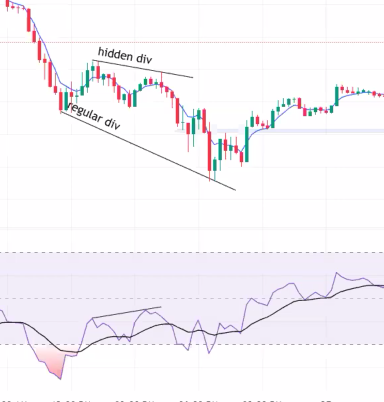
1. Regular Divergence (Used for Pullbacks & Reversals)
Occurs at extreme market condition levels (above 70 or below 30).
- Bearish Regular: Price makes a Higher High (HH), but RSI makes a Lower High (LH). Indicates buying momentum is dying.
- Bullish Regular: Price makes a Lower Low (LL), but RSI makes a Higher Low (HL). Indicates selling momentum is dying.
2. Hidden Divergence (Used for Trend Continuation)
Usually occurs inside the normal 30 to 70 range while a strong trend is underway.
- Bullish Hidden: Price makes a Higher Low (HL), but RSI makes a Lower Low (LL). Signals the uptrend is ready to resume.
- Bearish Hidden: Price makes a Lower High (LH), but RSI makes a Higher High (HH). Signals the downtrend is ready to resume.
Caution: Avoid taking counter-trend trades on Regular Divergence alone. Trading against a strong macro trend based strictly on an indicator is a quick way to blow an account.
4. How to Confirm and Trade RSI Divergence
Do not enter a trade simply because a divergence line appears on your indicator. You need Price Action Confirmation to enter.
Method A: Engulfing Candle Trigger
Wait for a strong momentum candle in the direction of the divergence.
- The 30% Rule: A valid breakout/engulfing candle should close at least 30% beyond the body of the previous candle.
- Execution: Once the strong momentum candle closes, enter on a minor pullback/retest of that candle’s range.
Method B: The 5 EMA Crossover Confirmation
To filter out noise, overlay a 5-period EMA on your price chart:
- Identify the divergence between swing legs.
- Wait for a strong momentum candle to cross and close beyond the 5 EMA.
- Enter in the direction of the crossover, placing your stop loss safely beyond the recent swing structure wick.
[INSERT IMAGE HERE: Price Action Entry — 5 EMA Crossover with a 30% Engulfing Candle Confirmation]
Summary Checklist
- Spot Swing Legs: Only look for divergence across consecutive swing highs (overbought) or swing lows (oversold).
- Identify Divergence Type:
- Regular: Extreme levels (>70 or <30) $\rightarrow$ Potential pullback.
- Hidden: Mid-range (30-70) $\rightarrow$ Trend continuation.
- Demand Confirmation: Never enter blind. Wait for a 5 EMA crossover or an engulfing candle that closes at least 30% larger than the prior candle body.