In our previous guide on the Climactic Action Bar, we looked at how extreme volume sweeps can mark immediate market reversals. But what happens when the market doesn’t reverse in a single candle, or when institutional buying/selling takes a bit longer to absorb the order flow?
This is where two powerful Volume Spread Analysis (VSA) concepts come into play: Stopping Volume and the Two-Candle Retracement.
Understanding these setups will help you identify exactly where institutional smart money is stepping in to halt a move and give you high-probability entries without guessing.
1. What is Stopping Volume?
Stopping Volume occurs when a strong, fast-moving trend suddenly slams into a brick wall of institutional orders.
Imagine a heavy freight train moving at full speed. It cannot stop instantly; applying the brakes creates massive friction and heat before the train grinds to a halt. In trading, that friction is high volume.
Characteristics of Stopping Volume:
- The Context: Appears during an active, aggressive trend (e.g., a sharp sell-off).
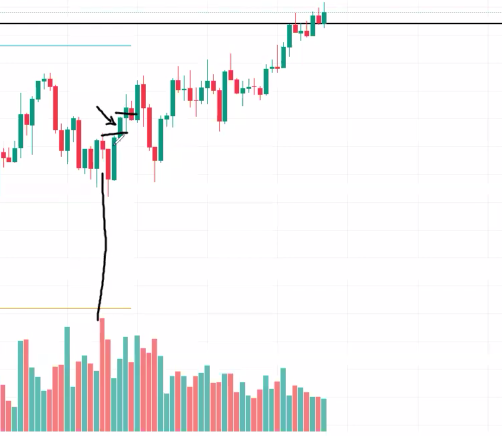
- The Volume: A sudden, exceptionally high volume bar—often the highest volume on the chart.
- The Price Action: Despite the massive volume, the candle body remains surprisingly small, or price leaves a notable wick against the trend.
- The Meaning: Big smart money traders are absorbing all the market orders from panicked retail traders. High volume with little price progression proves that institutional limit orders are stopping the move.
Key Rule: High volume should yield big price movement. If volume is massive but price movement stalls, smart money is absorbing the flow and stopping the trend.
2. What is a Two-Candle Retracement?
While a single Climactic Action Bar reverses in one candle, smart money often needs two distinct candles to complete a liquidity sweep and reverse price momentum. This is known as a Two-Candle Retracement or a Two-Bar Reversal.
How the Two-Candle Pattern Works:
- Candle 1 (The Sweep / Climax):
- A large-bodied candle drives aggressively beyond a key support or resistance level to sweep stop-loss liquidity.
- Volume on this first candle is exceptionally high.
- Candle 2 (The Immediate Rejection):
- The very next candle immediately reverses direction, closing back inside the previous market structure.
- This second candle confirms that the first candle was a fakeout (liquidity sweep) rather than a true breakout.
[INSERT IMAGE HERE: Two-Candle Retracement showing Candle 1 sweeping liquidity and Candle 2 closing back inside structure]
3. How to Trade the Two-Candle Retracement
Just like with single-candle climaxes, the secret to trading a Two-Candle Retracement safely lies in how the market pulls back afterward.
The Execution Checklist:
- Identify the Two-Candle Pattern: Spot a high-volume liquidity sweep candle followed immediately by a strong rejection candle closing back in structure.
- Observe the Retracement: Wait for price to pull back gently into the range of the two-candle pattern (often retesting the 50% zone of the two-bar structure).
- Check the Volume on Retracement: The pullback into the pattern MUST happen on low, declining volume.
- High volume on the sweep = Smart money entering.
- Low volume on the pullback = Sellers/Buyers are completely exhausted.
- Direct Entry: Enter your trade on the low-volume test without waiting for a secondary sweep or complex lower-timeframe Break of Structure (BOS).
- Stop Loss: Place your stop loss safely below/above the extreme wick of the two-candle structure.
[INSERT IMAGE HERE: Complete setup — Two-Candle sweep with high volume followed by a low-volume test and entry]
Stopping Volume vs. Two-Candle Retracement: Quick Comparison
| Feature | Stopping Volume | Two-Candle Retracement |
| Candle Count | Usually 1 primary absorption candle | 2 distinct candles (Drive + Rejection) |
| Price Action | Narrow body or long wick on huge volume | Candle 1 breaks out; Candle 2 immediately closes back inside |
| Market Meaning | Institutional absorption of trend momentum | Institutional liquidity sweep & trap |
| Entry Trigger | Low-volume test into the stopping candle | Low-volume test into the 2-candle range |
Final Thoughts
Market traps happen fast, but volume always leaves clues.
When you see stopping volume or a two-candle reversal on heavy volume, don’t rush to chase the move. Wait for the market to calm down and pull back on light, quiet volume—that low-volume retracement is your signal that the path of least resistance is clear.